A wall in Lugano, Switzerland, shifts its image several times a day. No one repaints it. No projector beams onto its surface. The mural – “Celsius” by the Swiss duo NEVERCREW – is coated in thermochromic paint that reconfigures its color palette in response to ambient temperature. The whale depicted on the wall appears, dissolves, and reappears as the weather changes, turning a building facade into a real-time climate gauge.
This piece belongs to a growing body of street art that treats chemical reactions not as side effects of material decay but as the primary creative medium. Oxidation, phosphorescence, thermochromism, acid etching – each process relies on molecular transformation to generate visual effects that no pigment or pixel can replicate. The artwork does not merely depict change; it undergoes change.
For anyone curious about the chemistry behind these transformations – from electron excitation in phosphorescent pigments to redox reactions in rusting iron – tools like Chem AI can parse any equation or concept into a step-by-step explanation, bridging the gap between studio practice and molecular science.
Four Reactions, Four Palettes
The chemical processes that street artists have adopted share one trait: they alter the physical or molecular structure of a material in ways visible to the naked eye. Four categories dominate the field.
| Reaction type | Mechanism | Visible result |
| Oxidation | Iron reacts with O2 and H2O to form iron(III) oxide (Fe2O3⋅nH2O) | Ochre, sienna, umber patinas on metal and paper |
| Thermochromism | Leuco dyes in microcapsules undergo reversible protonation/deprotonation at a specific temperature threshold | Color changes triggered by heat or cold |
| Phosphorescence | Europium-doped strontium aluminate (SrAl2O4:Eu2+) absorbs UV photons, then slowly re-emits them as electrons decay from excited 4f⁶5d¹ states | Afterglow lasting minutes to hours after sunset |
| Acid etching | Strong acids dissolve mineral substrates – e.g., CaCO3+2HCl→CaCl2+CO2+H2O | Permanent subtractive marks on stone, glass, metal |
Each reaction imposes its own constraints on the artist: time, temperature, toxicity, reversibility. These constraints, in turn, shape the aesthetics.
Rust as Composition: Brian Kirk and Controlled Oxidation
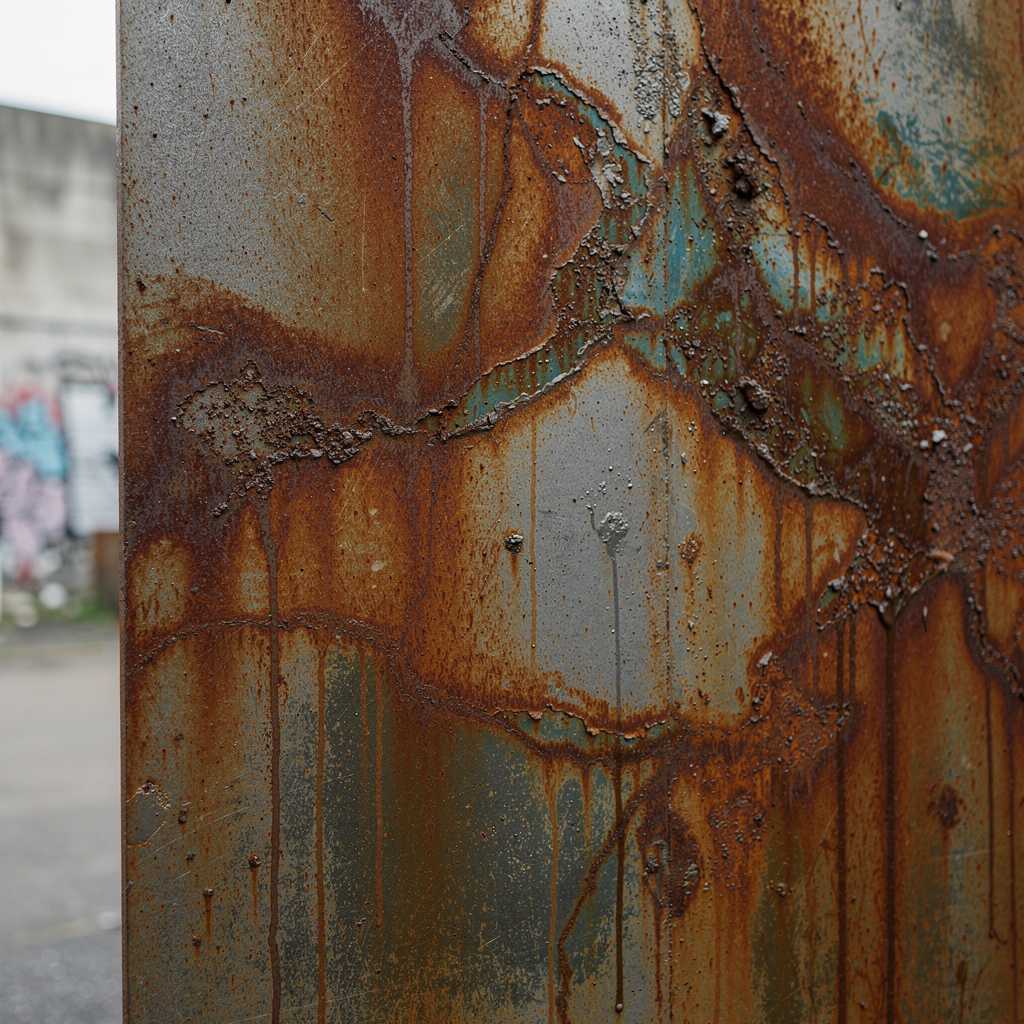
Brian Kirk, a sculptor and printmaker based in Virginia, discovered rust art by accident. He left a cardboard box on his steel welding table; two months later, the oxidation pattern pressed into the cardboard stopped him mid-stride. Five years of systematic experimentation followed.
Kirk’s method is straightforward in principle and unpredictable in execution. He places flat steel objects – keys, wire, handmade iron sculptures – between two sheets of archival watercolor paper or linen. The stack goes into a bath of soapy water, weighted beneath a marble slab. It stays submerged for several months. During that period, a redox reaction occurs: iron atoms lose electrons to dissolved oxygen, forming hydrated iron(III) oxide, which deposits onto the paper fibers in swirling, cellular patterns.
The results are rust prints – ghostly impressions in amber, sienna, and umber, with iron oxide particles pooling in halos around the metal objects. Kirk has described the process as “unpredictable – and that’s what makes it interesting to me.” Each soak produces two distinct prints: the top sheet tends toward crisp edges, while the bottom sheet absorbs more waterborne oxide, yielding softer, more diffuse imagery.
His 2018 solo exhibition “Natural Reaction” at The Art League Gallery in Alexandria, Virginia, showcased this body of work. Pieces like Votive Hand – a steel palm cut with a plasma cutter, then reborn through oxidation onto paper – drew from the Hopewell Indian mica effigy hands found in burial mounds near Chillicothe, Ohio.
The metaphor is direct: iron surrenders its structure to oxygen and water. The sculptor who once fought corrosion on his steel pieces now courts it. Rust art is additive and subtractive simultaneously – the metal loses mass while the paper gains image. No Ctrl+Z reverses what time and oxygen have done.
Thermochromic Walls: NEVERCREW’s “Celsius”
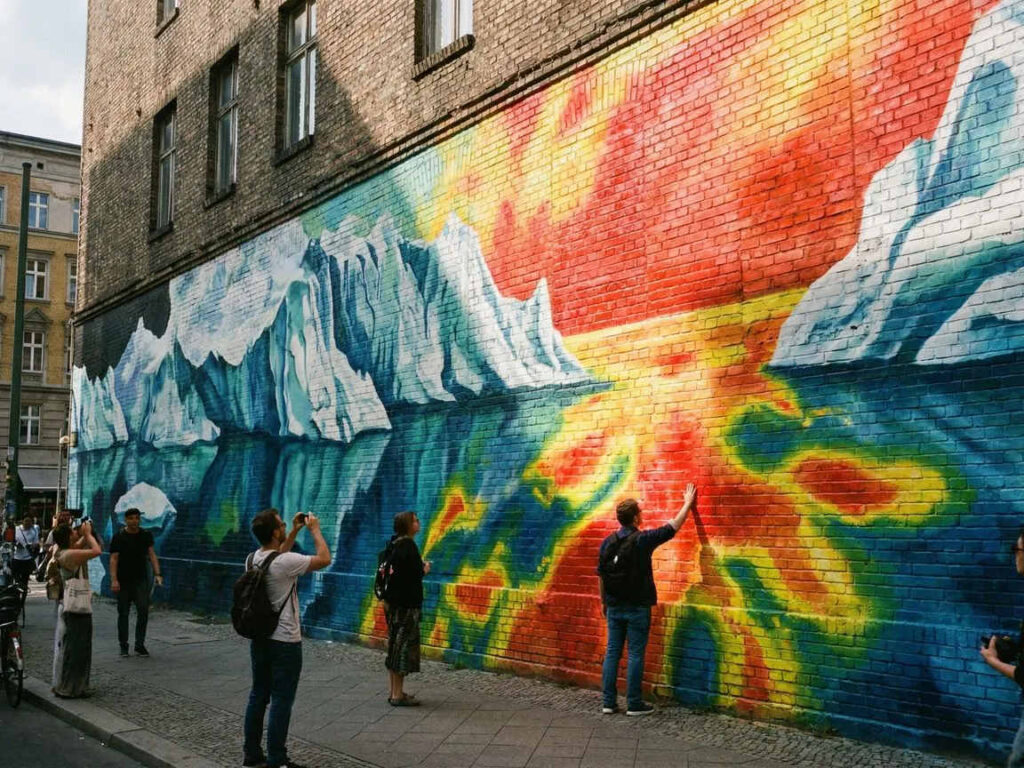
Christian Rebecchi and Pablo Togni – the Swiss duo behind NEVERCREW – have been working for years on artworks that react directly to environmental conditions. Their 2019 mural “Celsius,” realized at Spazio Morel in Lugano, uses thermochromic paint to create a surface that changes appearance with temperature fluctuations.
As NEVERCREW describes it: “Thermochromic paint allows us to create an immediate transformation and at the same time a silent litmus paper of the actual situation. ‘Celsius’ becomes then a timeline and a scale who wants to relate with today’s global and local choices while unavoidably including past and future in an interconnected overview.”
The chemistry behind thermochromic paint centers on leuco dyes sealed within microcapsules, typically 3–5 μm in diameter. A common system uses crystal violet lactone (CVL) combined with a weak acid such as bisphenol A (BPA), dissolved in a polar solvent like dodecanol. When the solvent is solid (below the activation temperature), the dye remains in its colorless lactone form. When temperature rises and the solvent melts, the acid dissociates, protonates the dye, opens the lactone ring, and shifts its absorption spectrum – producing deep color. The process reverses upon cooling. Commercial thermochromic paints are available for activation temperatures ranging from roughly −5°C to 60°C.
What makes “Celsius” distinct from gallery-scale thermochromic experiments is its environmental exposure. The wall faces genuine weather fluctuations, not controlled heat lamps. The mural’s appearance at 8:00 AM differs from its state at 2:00 PM; a January viewing offers a different palette from an August one. This uncontrolled variability is the point – the building becomes, as the artists put it, a litmus paper for actual climatic conditions.
The mural also presents a documentation problem. A photograph captures one state of the work at one temperature at one moment. It cannot encode the temporal dimension – the waiting, the shift, the return. This property places thermochromic street art in direct tension with the Instagram-driven consumption model that dominates contemporary mural culture.
After Dark: Phosphorescent Paint in Public Space
The phosphorescent pigments used in contemporary glow-in-the-dark street art are overwhelmingly based on europium-doped strontium aluminate (SrAl2O4:Eu2+), often co-doped with dysprosium (Dy3+). Developed by Yasumitsu Aoki at Nemoto & Co. in Japan and patented in 1994, this compound produces afterglow roughly 10 times brighter and 10 times longer-lasting than the copper-activated zinc sulfide (Cu:ZnS) used in older glow-in-the-dark products.
The mechanism operates as follows: incoming UV or visible-light photons excite valence electrons of the Eu2+ ion from the 4f7 ground state to the higher-energy 4f65d1 state. The subsequent slow decay back to the ground state releases photons in the green range (peak emission around 520 nm for SrAl2O4). The dysprosium co-dopant creates trap states in the crystal lattice that extend the duration of emission, producing persistent luminescence that can last for hours.
The excitation wavelength range spans roughly 200–450 nm, meaning both UV light and portions of visible sunlight can charge the pigment. Different aluminate stoichiometries produce different emission colors: SrAl2O4 emits green (520 nm), SrAl4O7 emits blue-green (480 nm), and SrAl12O19 emits blue (400 nm). The material is chemically inert, non-toxic, and non-radioactive.
Reskate Studio: Dual-Narrative Murals
María López and Javier de Riba – the Barcelona-based duo behind Reskate Studio – have built their practice around photo-luminescent murals that present two distinct readings: one in daylight, another after dark.
Their ongoing Harreman Project (from the Basque word for “relationship”) began during an artist residency in Vienna in 2015 and expanded to the public street after an invitation to a street art festival in Romania. Each mural is painted with a combination of conventional pigment and photo-luminescent paint. During the day, the composition appears vibrant but seemingly complete. At night, hidden layers glow – revealing additional figures, objects, or messages that reframe the daytime image.
In the 2022–2023 mural “Eulalia” in Mérida, Spain, a young female figure holds a potted plant in daylight. After sunset, a glowing blue mist materializes around the figure – referencing the legend of Eulalia, the 4th-century patron saint of Mérida, who was tortured for defending her beliefs. The mist, according to legend, appeared to conceal the atrocity.
Reskate has stated that their location selection is rigorous: “We research the light pollution around the wall and other considerations such as how interesting the location is, the conditions of the surface, visibility, safety.” Walls in areas with low ambient light produce the strongest afterglow effect. Some installations use pre-set timers or city-synchronized lighting to activate the phosphorescent layer; others let viewers “paint” the wall with their phone flashlights.
The dual-reading format raises an experiential challenge: most viewers encounter one version – day or night – and see the other only in photographs. The artwork is structurally incomplete unless experienced twice, at different times. Reskate has acknowledged this by adapting many murals into limited-edition screen prints – also glow-in-the-dark – to carry the concept into private spaces.
SpY: “I’m Not a Real Artist”
For Nuit Blanche 2014 in Paris, the Madrid-based urban artist SpY painted the phrase “I’m not a real artist” in phosphorescent paint across a building facade. During the day, the text was nearly invisible. Spotlights and sunlight charged the phosphorescent paint throughout daylight hours. When night fell and the lights switched off, the phrase glowed autonomously against the dark building – a self-negating claim made visible by the very technique that constitutes artmaking.
The piece compressed several tensions into a single chemical event: authorship and anonymity, visibility and concealment, the ephemeral charge (sunlight) and the persistent emission (afterglow).
Bogi Fabian: Multiluminous Environments
Hungarian artist Bogi Fabian has developed a technique she calls “multiluminism” – combining fluorescent (UV-reactive), photoluminescent/phosphorescent (glow-in-the-dark), and traditional daylight pigments into a single work. The result is a painting or mural with three distinct appearances: one under normal light, one under UV (365 nm) illumination, and one in complete darkness.
Her installations span the northernmost public library in Longyearbyen (Svalbard, Norway), a hostel in Amsterdam, exhibition rooms in Austria, and lecture halls in Hungary. Each work is site-specific, and materials are selected during brainstorming sessions with clients. Fabian describes her mission as creating “unique spaces, giving them an identity and a soul.”
The technical achievement lies in layering: the traditional (daylight-visible) pigment must not absorb or block the UV wavelengths needed to excite the fluorescent layer beneath, while the phosphorescent layer must receive enough charge to glow after all light sources are removed. Managing these three spectral regimes on a single surface requires precise material knowledge – the kind of applied photochemistry that sits closer to optics engineering than conventional painting.
The Destructive Edge: Acid Etching
Acid-etched graffiti occupies the most contested boundary in reactive street art. The chemistry is straightforward: strong mineral acids – hydrochloric (HCl), sulfuric (H2SO4), or hydrofluoric (HF) – dissolve the molecular structure of the target surface.
On limestone and mortar:
CaCO3+2HCl→CaCl2+CO2↑+H2O
On glass and ceramic:
SiO2+6HF→H2SiF6+2H2O
Unlike spray paint, which adheres to a surface and can be removed, acid etching removes the surface itself. The mark is subtractive: material is dissolved away at the molecular level, leaving pits, frost, or discoloration that cannot be washed off.
This permanence is precisely what makes acid etching a serious form of urban vandalism. Data from Transport for London, cited by graffiti-removal specialists DUA London, shows a 40% rise in acid-etched incidents on Underground station facades in recent years. The technique is fast, difficult to detect in progress (acids can be concealed in small bottles), and virtually irreversible without professional restoration involving chemical neutralization, micro-sandblasting, or full substrate replacement.
Yet acid etching also has deep roots in fine-art printmaking – intaglio, copper-plate etching, aquatint – where controlled acid bites create the tonal range that makes Rembrandt’s prints sing. The tension between sanctioned and unsanctioned use of the same chemical process exposes a fault line: the reaction is identical, but context determines whether the result is preservation-worthy art or property destruction.
Chemical Art in a Digital World
Reactive art presents a problem for the post-internet viewer. Digital images are static, infinitely reproducible, and temperature-independent. A thermochromic mural, a phosphorescent wall, a rusting print – each of these exists on a time axis that a screen cannot encode. The glow fades. The color shifts. The rust advances. Photographing these works captures a slice, not the process.
Some artists lean into this tension. Reskate’s day/night murals are designed to generate comparison images – the Instagram “before and after” – while insisting that the full experience requires physical presence. NEVERCREW’s “Celsius” treats environmental variability as content, meaning no two viewings are identical. Kirk’s rust prints are finished objects, but the process itself (months of slow oxidation) resists the speed of digital culture.
Other practitioners see reactive chemistry as a direct counterstatement to the screen. A wall that changes with temperature has no file format. A glow that dims over minutes cannot be paused. An acid etch cannot be undone. These properties – irreversibility, time-dependency, environmental sensitivity – are exactly what digital reproduction strips away.
Whether this constitutes a new aesthetic, a form of protest, or simply a material preference depends on the artist. What the chemistry provides is a constraint that forces both maker and viewer to reckon with physical reality – with molecules, temperatures, photons, and the passage of time.
Exploring the Science
For those who want to trace the reactions behind a specific artwork, the resources are increasingly accessible:
- Material Safety Data Sheets (MSDS) for aerosol paints and specialty pigments list the chemical compounds inside each can – a useful starting point for any artist curious about what they are actually spraying.
- Strontium aluminate datasheets explain the phosphorescent compounds behind glow-in-the-dark paint; europium-doped variants (SrAl2O4:Eu2+,Dy3+) are the current industry standard.
Every color is a quantum event. Every glow is an electron falling home. Reactive art makes that visible – not as a diagram, but as a wall, a print, a building facade that breathes with the weather and darkens with the night.